
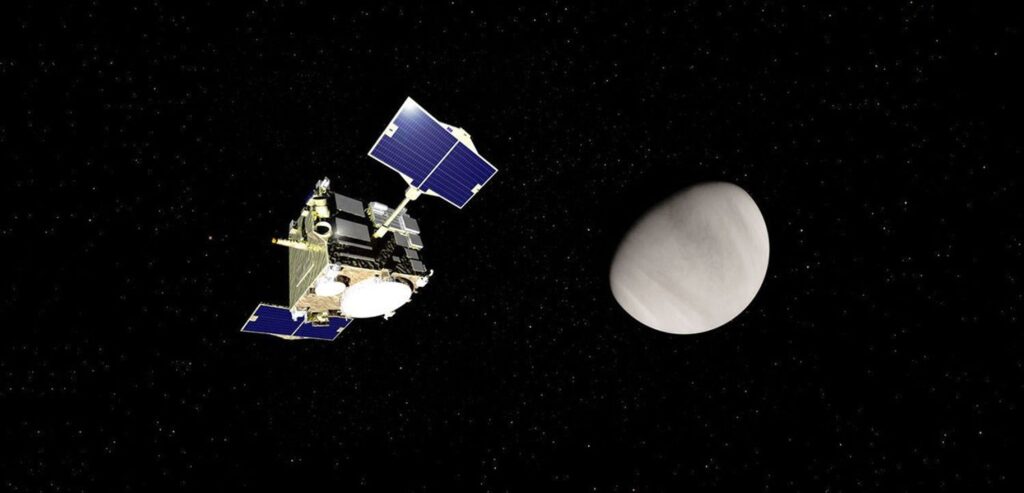
The Japanese Aerospace Exploration Agency(JAXA) has declared that the humanity’s last spacecraft orbiting Venus, Akatsuki, officially dead. This comes over a year since the space agency lost contact with the spacecraft.
The Venus climate probe — as it has been known, last responded to Japanese mission control before May 29th, 2024.
Venus is the second planet orbiting around the sun, and the Akatsuki’s mission has impacted how the Space community views the Earth Sized neighbor nearer to the sun.
One of the JAXA officials were quoted saying, “This was a mission that changed our view of our Earth-sized neighbor, and laid the path for new discoveries about what it takes to become heaven or hell,” possibly referring to high temperature and pressure in Venus, compared to Earth.
Based on JAXA’s report, the Akatsuki’s mission lasted longer than it was predicted, almost tripling it’s 4.5-year design lifetime. This is despite the challenges it encountered while trying to get to the Venus’ orbit.
The Akatsuki mission was launched in 2010, and the spacecraft experienced main engine failure along the way, causing near failure of the mission. With the main rocket engine dead, the spacecraft missed the crucial venus orbit entry burn. The team behind the mission had to be creative and used less powerful thrusters, initially meant for altitude control and fine adjustments.
Five years after orbiting the sun, nearly five years after failed entry, when the spacecraft drew closer to Venus again, the mission tried and succeeded in orbital insertion.
Throughout the Akatsuki’s mission, 178 journal papers have been written.

The Findings
In Venus, the winds whips at very high speeds, almost 60 times faster than the planet rotation. The Venusian clouds, on the other hand, whip around the planet in about four earth days.
Venus has a slow rotation speed, and a single Venusian day, according to JAXA, is equivalent to 243 earth days. However, Venus orbit around the sun in a period equivalent to 225 earth days.
Akatsuki initially launched with six instruments, all of which were still working when it successfully entered Venus orbit in 2015. Two infrared cameras, however, failed a year later. The four remaining instruments continued to work normally, until the last time the spacecraft responded to mission calls in 2024.
Despite the mission’s end, JAXA believes that learning more about Venus will require new similar space missions.
Future space missions still in development, like NASA’s DAVINCI and VERITAS projects promises to further advance the knowledge on Venus.