

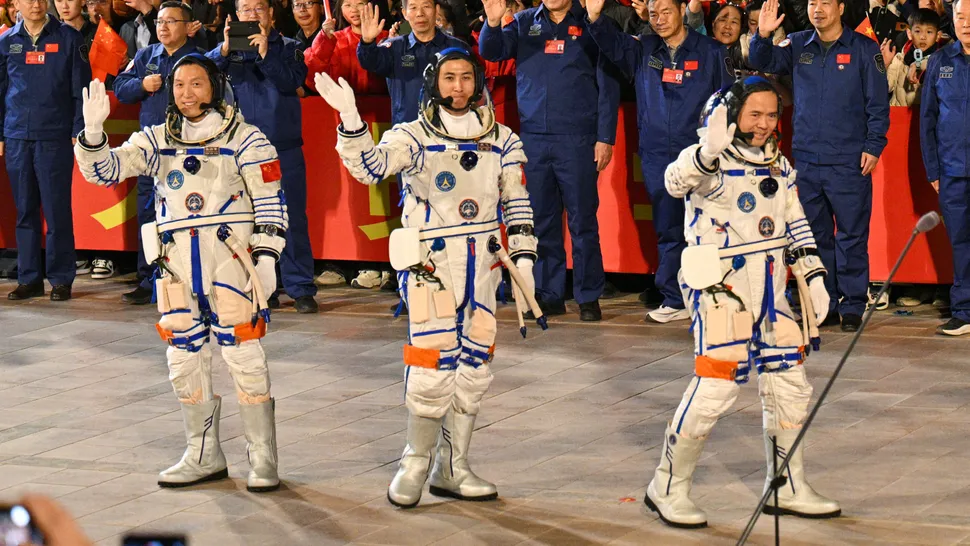
A routine crew rotation aboard China’s Tiangong space station has turned into a high-stakes waiting game, as three astronauts are left without a ride home following damage to a spacecraft from suspected space debris. In a remarkable demonstration of its contingency planning, China is now accelerating the launch of a replacement “lifeboat” to ensure the crew’s safety.
Three Chinese astronauts, known as taikonauts, are currently orbiting Earth aboard the Tiangong space station without a designated return vehicle. The unusual situation arose after the spacecraft that brought them to the station was used to ferry the previous crew back to Earth.
The chain of events began with the Shenzhou-20 (SZ-20) capsule, which was docked at the station. An inspection revealed small cracks in a window, believed to have been caused by an impact from space debris. With the SZ-20 deemed unsafe for the extreme conditions of atmospheric reentry, China’s Manned Space Agency (CMSA) made the decisive call to prioritize the safety of the returning Shenzhou-20 crew.
They were brought home safely on November 14th aboard the Shenzhou-21 spacecraft—the very vehicle that had just delivered the new crew to Tiangong on October 31st.
The Waiting Game in Orbit
This “lifeboat swap” leaves the current Shenzhou-21 crew—commander Zhang Lu, a veteran of a 2022 mission, and spaceflight rookies Zhang Hongzhang and Wu Fei—temporarily stranded. Wu Fei holds the distinction of being the youngest taikonaut in China’s astronaut corps. While the crew is safe and continuing their planned six-month mission, the absence of a return capsule presents a risk should an emergency arise on the station itself.
Operation Space Rescue
However, China was prepared for such a scenario. The nation’s space program maintains a Long March 2F rocket and a backup Shenzhou spacecraft in a state of near-readiness for precisely this type of emergency.
The rescue mission, designated Shenzhou-22, is now being fast-tracked. Airspace closure notices suggest a launch is being targeted for around November 25th from the Jiuquan Satellite Launch Center in Inner Mongolia. The Shenzhou-22 will launch without a crew and will carry essential cargo, including food and other supplies for the orbiting taikonauts. Its primary mission, however, is to dock with Tiangong and serve as the new, reliable ride home for the Shenzhou-21 crew at the end of their tour.
While the standby system is designed for a rapid launch in as few as 8.5 days, the complexities of orbital mechanics—waiting for the space station’s path to align perfectly with the launch site—mean that by the time Shenzhou-22 arrives, nearly three weeks will have passed since the damage was first discovered.
A “Massive Wake-Up Call”
This incident is the second in recent years to see astronauts left without their original return vehicle, highlighting the growing dangers posed by space debris. In June 2024, NASA astronauts aboard the International Space Station (ISS) were left in a similar situation when their Boeing Starliner capsule experienced technical issues and was returned to Earth uncrewed.
These events serve as a “massive wake-up call” for all space-faring nations about the increasing threat of orbital debris and the critical need for robust rescue capabilities. With tens of thousands of tracked objects—and countless smaller, untraceable fragments—whizzing around the planet at extreme velocities, the risk of damaging impacts on vital spacecraft is a constant and growing concern.